The AI investment wave in PropTech is raising the bar for landlords. Space planning and renders are the highest-ROI place to begin.
- Proptech VC reached $16.7 billion in 2025, with AI-native companies growing at nearly double the rate of traditional software.
- Capital partners are beginning to factor AI readiness into how they evaluate commercial assets and management quality.
- For landlords, AI-powered space planning and renders deliver the most visible ROI and the most defensible starting point.
Commercial landlords in 2026 are operating in a market where AI readiness has moved from optional to expected. The $16.7 billion channelled into proptech in 2025 signals the operational standards lenders and investors are beginning to apply. A Bisnow analysis published this month confirmed that AI-native proptech companies grew their share of venture investment at 42% annually, nearly double the 24% rate of conventional software.
The downstream effect for landlords is tangible. Lenders and institutional investors are beginning to include AI readiness in portfolio and refinancing reviews. January 2026 alone saw $1.7 billion in proptech investment, a 176% year-on-year increase. A portfolio that cannot demonstrate AI-enabled operations is increasingly the one fielding uncomfortable questions.
Capital is consolidating around platforms that automate measurable outcomes. Tools that assist workflows are being replaced by platforms that drive them. The operators who move first set the benchmark others are judged against. For most landlords, it is no longer whether to adopt AI. It is where to start, and what a credible adoption story looks like to a capital partner.
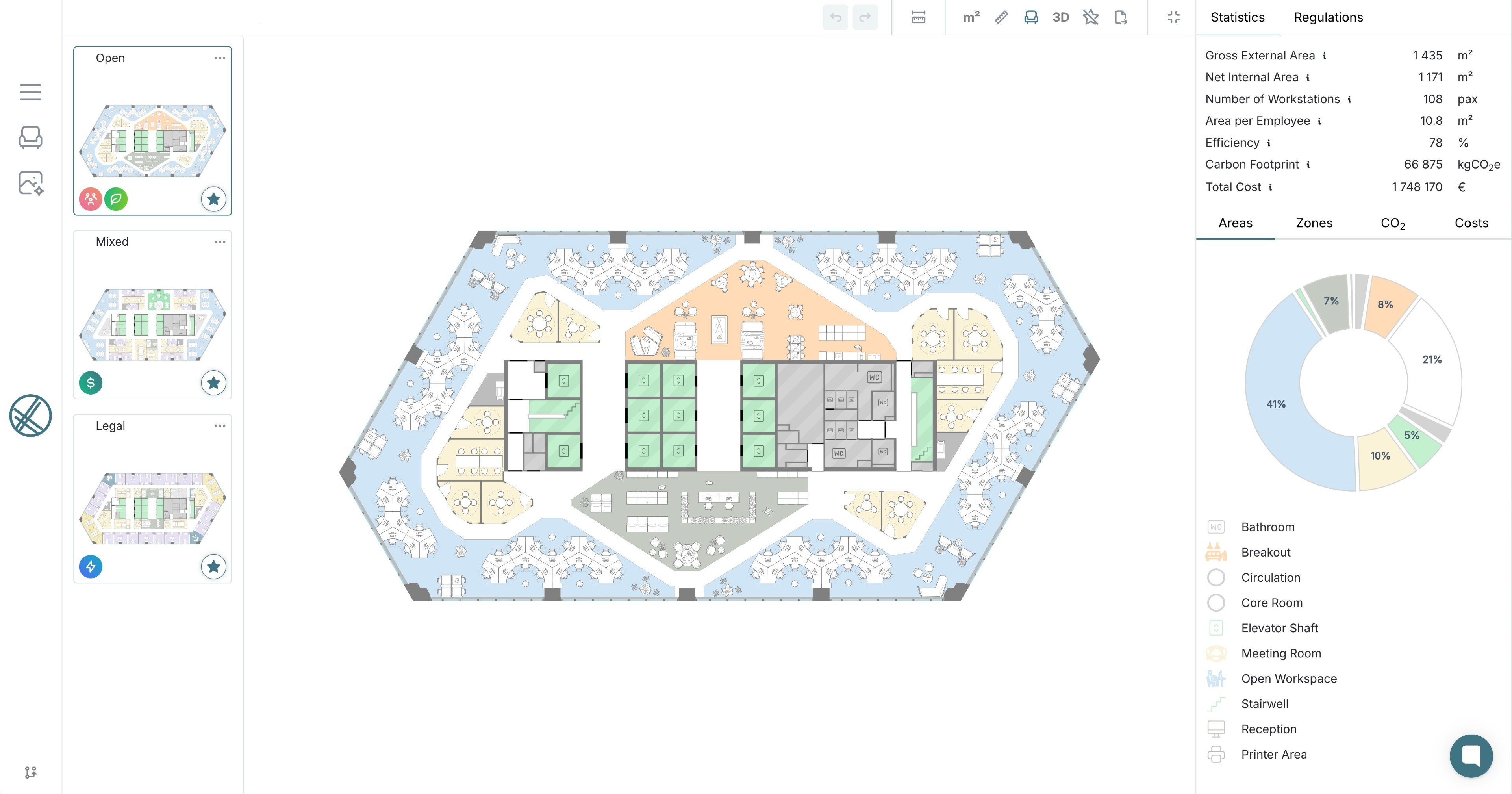
AI space planning sits at the centre of every leasing decision. Office test fits are where tenant interest converts to committed deal, and where traditional manual processes are the biggest bottleneck. laiout produces results that are immediate, measurable, and visible to every stakeholder in the room.
- Respond faster with plans and renders: Generate office layouts and photorealistic renders in minutes. Tenants see exactly what the space looks like occupied, in the same conversation, before they have considered the next building.
- Plan across a portfolio at scale: Office test fits that once took 10 or more hours to produce manually are completed in minutes, built on real occupier density and usage patterns rather than generic assumptions.
- Build a concrete AI narrative for lenders: When capital partners ask about AI in your operation, a planning process that runs in minutes is a live, operational answer, not something on the roadmap or under internal review.
Q1 - Which AI tools offer the best ROI for commercial landlords in 2026?
The highest-return entry point is where AI directly touches leasing revenue. AI-powered space planning and renders outperform traditional test-fit workflows on speed, cost, and tenant conversion, making them the most commercially defensible first adoption for most landlords.
Q2- How does AI space planning vs architect test fits compare for leasing speed?
Traditional test fits take one to three weeks per iteration and require dedicated architect time at every round. laiout delivers regulation-aware layouts and AI renders in minutes, allowing landlords to respond to multiple briefs simultaneously at a fraction of the cost.
Q3- Do commercial lenders check for AI adoption when reviewing real estate portfolios in 2026?
Increasingly, yes. A demonstrable, live AI workflow in leasing provides the operational evidence capital partners are beginning to require, moving the conversation from aspiration to proof.
The proptech investment wave will raise what investors and tenants expect from commercial operators over the next three years. The landlords building AI into core workflows today are not waiting for that standard to become explicit. They are already using it to win deals. Book a demo with laiout and see how AI-powered space planning and renders are helping commercial landlords convert faster and build a stronger story with capital partners.
Get laiout News and Updates right in your inbox.

March 26, 2026
AI vs Manual Workflows in CRE Brokerage: Why the Productivity Gap Is Already Costing Brokers Deals
March 11, 2026
Best AI Space Planning Tools for Commercial Designers in 2026: Automated Test-Fits vs Manual Workflows
March 11, 2026
Office Lease Expirations 2026 to 2028: What Landlords Need to Know About The Renewal Wave
We're always open to hearing from talented people. If you don't see an open role that fits, send a speculative application to careers@laiout.co.Tell us what you'd bring and why laiout resonates with you.

Sign up to our newsletter


.svg)
.svg)


.svg)

